.svg)
.svg)


Gavin Brivik is an award-winning composer and music producer who’s known for his unique combination of indie rock, folk, orchestral, and electronic influences.
He’s behind the scores of projects like the Warner Bros and HBO Max show The Pitt, Neon’s How to Blow Up a Pipeline, and most recently, IFC and Shudder’s Faces of Death, starring Barbie Ferreira, Dacre Montgomery, Charli XCX, and Josie Totah.
In celebration of the release of the film, we had the unique opportunity to sit down with Brivik to hear insights into his compositional process for the score of Faces of Death—read on for highlights.
An interview with Gavin Brivik on scoring Faces of Death
How would you describe the sonic identity of Faces of Death in your own words?
Gavin Brivik: I wanted to make the score sound as if it were playing on a very worn, destroyed, and broken VHS tape. What does it sound like if that tape is playing fast forward, or at times reversed? We were extremely inspired by William Basinski‘s The Disintegration Loops. The director, Daniel Goldhaber, writer / producer, Isa Mazzei, and I imagined the score being played on one of William’s tape loops at the point of disintegration.
The other half of the score lives in the modern internet culture of sampled music. The main character is a content moderator and is constantly scrolling through the deepest and darkest pockets of the internet. That’s where the Moment sample packs and hyperpop inspired us. I loved using these samples to cut between sharp transitions and play into the humor and horror of the film. The very fast tempos of hyperpop felt aligned with the idea of a destroyed tape playing in fast forward. It felt like a nice marriage of genres and sounds.
So, there’s two worlds for the score—there’s the late-’70s horror aesthetic with taped synths, found sound recordings, and dry orchestral strings and brass, alongside the distorted, funny, and super fast hyperpop music.
What did your collaborative process look like?
For all of the films I’ve worked on with Daniel and Isa, we write music ahead of the picture. By this I mean that we write a lot of the score while the film is in pre-production. I basically write an entire album inspired by the script so that Daniel and Isa can go into the editing process with a lot of my music already made.
One process we love doing for this pre-score is using a lot of found sound samples. For this film, I recorded the actual 1970s VHS tape of Faces of Death—I won a competitive bidding war for that tape on eBay, haha. I took the tape and recorded it fast forwarding in a small TV set, holding the mic right up to the tape deck.
We also recorded the tape, pushing it in and out of the deck to make weird percussive sounds, which ended up being the core percussive elements of the score. I also wrapped a VHS tape around instrumentalists’ fingers, including the saxophonists, and we used contact mics to record these crunching tapes, moving across the saxophone key clicks.
We also recorded a grand piano, pressing down the sustain pedal and laying VHS tape across the resonating piano strings. Then, I would have a brass player face their horn into the piano bed and play their parts, which would vibrate the piano strings, shaking the VHS tape. It created a lot of these ASMR-type sounds that were heavily featured in the score.
When it came to working with Cecile Believe and bringing Umru onto the project, I heavily relied on the Moment sample packs, which I later started incorporating into the score as well. The director and writer tasked me with writing a lot of the short music clips in the reels and video clips. Some of these were dance videos or funny videos that we all scroll across every day. I wanted to bring some humor into the music to balance out the darkness. I started becoming obsessed with artists like SOPHIE, Slayyyter, Charli XCX, 100 gecs, Dorian Electra, A.G. Cook, and Alice Longyu Gao.
Once we settled on this direction for a lot of the diegetic music in the film, I started reaching out to producers, and my buddy Dillon Baldassero introduced me to Cecile, who was so generous to come on board. I had written a bunch of instrumental tracks heavily featuring the Moment loops, and I sent these over to Cecile. She reworked the stems and toplined the tracks.
Cecile also suggested working with her friend Umru, who I was already a huge fan of, especially after deep diving into the producers behind Pop 2. Umru and Cecile wrote their song “Follow Me” for a needle drop moment in the film. They would send passes of the song to Danny, and Isa would give notes on production and lyrics.
What influences (film, music, or otherwise) were you thinking about when scoring Faces of Death?
I was truly thinking about the iconic sounds of late 1970s horror films and the electro-acoustic music of the time period. Composers like Jerry Goldsmith, Tangerine Dream, Xenakis, Boulez, Berio, John Cage, and the school of musicians and researchers behind IRCAM.
When we start moving into hyperpop and the experimental music of our era, artists like Death Grips, Zach Hill, SOPHIE, Kim Petras, Princess Nokia, Slayyyter, Charli XCX, 100 gecs, Dorian Electra, A.G. Cook, Aphex Twin, OPN, Umru, Cecile Believe, Alice Longyu Gao, Petal Supply, Tracey Brakes, Bladee, food house, Fraxiom, death’s dynamic shroud, and meat computer.
How did you utilize loops and samples in a film scoring context?
The main Splice loops I used in the score were Umru‘s percussive and drum samples, specifically in umru – sound cache and umru – sound cache vol 3. One of my favorite things to do was to load his samples onto my keyboard with an arpeggiator and create filtered pulses that are used all over the score.
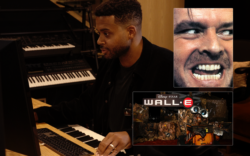
Here’s an example of a few ways I processed these:
You mentioned that the movie features both original songs and a score. Did one influence the other? How did you sonically connect the dots between the two?
I definitely think the score heavily influenced the songs, since most of that material came before. One way I tried to connect the dots was using synth sounds from the score in the production of the songs.
You’ll hear this most prominently in Cecile and I’s collaboration for the song “Ur Mad.” A lot of the ’70s synth bells, pad swells, and distorted VHS samples made their way into the song. Then, it became a cycle of taking samples and some sounds I found in the production of the songs and weaving them into moments of the score. I think it became a marriage.
The original Faces of Death score by Gene Kauer encompasses a wide range of styles, mixing orchestral and folk instrumentation with ambient sounds. How did you approach modernizing its sonic identity for 2026?
My favorite part of the original score was the sound of the violin ensemble, played very fragile and with no vibrato. It almost sounded like children were playing the instrument who just started learning, and the strings were wobbling in and out of tune. We tried to imitate this play style along with the brass used in the original movie. It’s tough to imitate something that’s so of its time period.
What unconventional sounds did you use for the score of Faces of Death? Can you walk us through a specific sound that’s featured in the film?
I was lucky enough to record the sounds of the lead actor, Dacre Montgomery, breathing and moaning into the microphone. He created these breathy pulses that I sampled and pitched all over the score. They were extremely demonic and airy.
I also recorded Barbie Ferreira typing on a computer keyboard rhythmically and we made interesting percussive click textures from these sounds. Another method was mentioned above, when I used resonating VHS tape across piano strings and wrapped instrumentalists’ fingers with tape while recording them with contact microphones.
We also smashed a few VHS tapes with a sledgehammer, and I took those recordings to a sound designer, Yair Elezar Glotman, and a composer, Paul Rudy, who ran them through modular rigs, outboard gear, and guitar pedals. We basically made our own sample pack just for the movie.
Here’s the video of us smashing the VHS tape:
Is there a particular piece of hardware or software that was essential during the creation of the score? Did you use analog gear, process in-the-box, or do some combination of both?
My bread-and-butter synth is the Prophet 6, which is used all over all of my work, including this one. I also combine a lot of my found sound sample work, primarily recorded with my Zoom H6, using a Schoeps CMC 6 stereo pair.
There are a few other favorite plugins I used on this score, a bunch of which I rented through Splice: Portal (great for granular distortion and warped tape effects), Little AlterBoy (amazing for pitch shifting with weird artifacts, and the drive is incredible), and RC-20 (which I love for the VHS / tape effects).
Lastly, what surprised you the most about working on Faces of Death? Were there any “aha” moments that occurred?
This was my first studio feature film score, and coming from an entirely independent working mindset, I realized the pace and intensity of this film required a larger team and collaborative approach. The “aha” moment was bringing on people like Cecile, Umru, Yair, Nick Zoulek, Paul Rudy, and many others to help me on the project.
I think many composers have this mentality that they need to do everything alone, or it’s “cheating,” which is silly. Songwriters and those in pop production have known that collaboration is the secret to any great track. Film composers know this too, but I come from the world of concert music, where there’s this solo working mentality. I’m glad I escaped that trap, and have embraced bringing people into my collaborations.
Explore more samples from Moment on Splice:
April 10, 2026