.svg)
.svg)

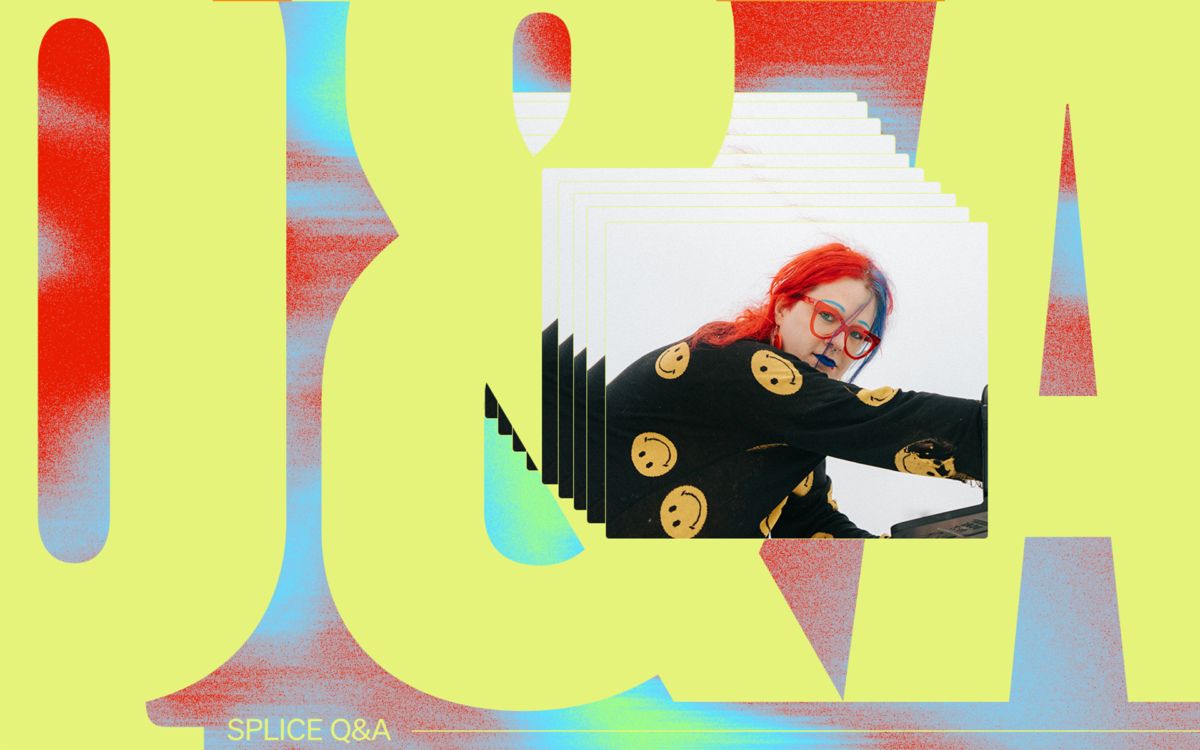
Angel Marcloid is a prolific music producer, composer, multi-instrumentalist, and mixing and mastering engineer who has established herself as an expert in experimental and progressive music.
In addition to her work as Fire-Toolz, Angel has released music under numerous pseudonyms including Nonlocal Forecast, MindSpring Memories, Angelwings Marmalade, World of White Ice, and more. In May of 2026, she released Lavender Networks on Warp Records.
In celebration of the release of her new sample pack infinite slime glitch, we had the opportunity to sit down with Angel for an exclusive interview where she discussed music production, plugins, DIY instruments, her creative philosophy, and more—read on for highlights.
Fire-Toolz on music production, influences, and the broader musical landscape
You’ve talked about your extensive use of guitar pedals, drum machines, and other hardware in the past. What role does hardware play in your production process now?
Marcloid: Hardware plays a similar but different role in my work now than it did when I played in bands. Most of the times I reach for a guitar or a bass, I end up processing it entirely with software rather than hardware. I don’t even have a working amp anymore, just an original Roland JC120 that needs repair (I adore that amp, and I will get it fixed eventually).
However, I still string together elaborate setups of pedals, cassette players, drum machines, contact and EMF mics, etc., for improv recording sessions, experimentation, and source material for sample packs. Oftentimes, I’ll just work with feedback, so the source material is the processing which is the source material.
So many pieces of those sessions end up being used in productions I work on, whether for myself or other artists. I have endless mounds of source material because I record everything. Poking through all of the recordings for gems is a time-consuming pain in the ass, but it’s where I get so much of my inspiration. From my own stash. And half the time, I don’t even remember what I used to get the sounds I was getting. It’s easier to keep track of gear when it’s digital.
What gear are you currently on the lookout for?
The physical gear I’m most interested in right now is tabletop units that do cool things, far beyond what I had access to when I was a hardcore pedal nerd: synths, samplers, feedback machines, or sequencers, with or without input jacks. I want to make dry sounds with this gear, and use software to process it. So, I don’t need anything too elaborate when it comes to physical gear. I’m mostly interested in creating source material with it.
Companies like Chase Bliss and Old Blood Noise Endeavors are taking “guitar pedals” to the next level and blurring the lines between stuffy guitarists who are into boutique pedals and adventurous experimentalists unafraid to get outlandish. I’m always looking for a good deal on neat stuff like that. When Chase Bliss came out with the Lossy pedal, it kind of kickstarted my interest in guitar pedals again. A pretty good resource for finding out about pedals like that is Emily Hopkins’ harp channel on YouTube.
I also do a lot of field recording now. I bought a really nice professional-grade recorder, and I have a bunch of mics left over from when my dad stopped doing live sound. I also bought a bunch of stereo EMF mics, and about six different kinds of contact mics, many of them made by the almighty Crank Sturgeon.
What plugins or software are essential to your sound?
For melodic material, the Korg M1, Korg Wavestation, and Roland D-50 have been essential so far. My holy trinity. I’ve also been using a handful of the same Alchemy presets since around 2017.
For mixing, the Blue Cat’s Chorus plugin, which is free, is for some reason my favorite software chorus right now, but it might just be because the default preset sounds so nice right off the bat that I keep reaching for it. It’s probably exactly the same as 200 other choruses out there. I use Valhalla reverbs a lot, and I like quite a few Ozone tools, like their multi-band Exciter and the Clarity module. Being able to pick a different distortion style for each of four frequency ranges is so helpful. It takes a chunk of time to set something like that up yourself in the DAW. FabFilter’s Saturn 2 is probably an even better tool for the same thing, but I’ve never really liked its interface. Ozone’s Clarity really helps with frequency masking in music where tones, timbres, dynamics, etc. are all changing all the time, or from song to song.
For sound design, I rely heavily on plugins by Glitchmachines, Inear Display, Lese, Aberrant DSP, MeldaProduction, Baby Audio, Lunacy, Freakshow Industries, Unplug Red, Nudist Audio, Tuğrul Akyüz, and AudioThing.
Unfortunately, the experimental electronic community is tired of granular synthesis. However, lately I have been bouncing back and forth between different granular apps like NeverEngineLabs’ NEL Incline, plugins like Baby Audio’s Grainferno, and my first granular love, MeldaProduction’s MGranularMB.
What are some of your favorite plugins to use the “wrong” way?
One of my favorite plugins to use the wrong way is MeldaProduction’s MHarmonizerMB, which I sometimes used on screamed or atonal yelled vocals. I also love using convolution reverbs (MeldaProduction has a few, and there are so many others) to put different instruments, and even the same instruments, in entirely different spaces at the same time, especially small spaces, to create uncanny weirdness. The guitar is in a small office down the hall, the vocalist is in your face with zero wet signal, the bassist is in the basement, the drummer is in a car garage in the next room, but there’s a wall in between.
I’m also constantly using quantization wrong, to jitter and mess up rhythms and melodies. Sometimes I will quantize a 4/4 beat to the wrong tempo, on a 9/8 grid, with some percentage of swing. Then, I’ll bounce that down and then turn on Logic’s speed flex mode and quantize it back to the beat, or to as much of the beat as I want. Then, you get a bunch of pitch variance from transient to transient.
I love the idea of carelessly messing something up and then meticulously crafting it into something useful. It feels like collaborating with something outside of myself. If I had the money, I would literally chuck guitars at concrete walls just to record it and pull pieces to turn into textural or rhythmic loops later.
What bands have some of your favorite guitar tones? Are there any in particular that inspired your own music?
I really enjoy so many different kinds of tones! I’m heavily inspired by deathcore and similarly extreme metal genres: bands like Distant, Humanity’s Last Breath, Extermination Dismemberment, Devourment, Sallow Moth, Disembodied Tyrant, Psycho-Frame, and the like.
Investing in the signature Gojira amp from Neural DSP was a wise move (even though I’m not particularly into the band’s music, their tones are fantastic). I used the Nolly amp for so long, but I’m done trying to dial in all this cleanliness, articulation, and djenty tone. Now, I just want to quad-track irritatingly high-gain tracks, and as long as my playing is clean and EQ’d, it sounds pleasingly disgusting.
I also love The Cure, so I have a plethora of guitar presets emulating their chorus-y, flanged-out, delay-soaked guitar tones, and I’ve used them in a number of No Joy songs so far, and some songs coming in the future with my friend Ben Levin, as well as in Fire-Toolz.
I also like to take that psychedelic sound to an extreme, stacking delays going at different speeds, multiple reverbs, different kinds of modulation, and moving filters to the point where a single chord can bloom into a whole galaxy. Even total incoherence can be super cool; attempts to control it at that point takes a good understanding of your processing. I used to create this scenario with massive pedalboards and now I’m relieved that I can do it even better, all the while sitting on my ass.
I also like the sound of small Fender tube amps sitting in the corner of a room, and I love the way spring reverb sounds when the overdrive comes after it. Reverb into distortion is always such an awesome way to get a really unique sound. The interplay between the reverb, delay, and how the distortion breaks up in response opens a world of opportunities!
What bands inspired you to incorporate blast beats into your work?
I wouldn’t say any particular bands inspired it. It’s more that I enjoy blast beats, so naturally I incorporate them into my music. I’ve been enjoying death metal and grindcore since I was really young, and later on got into powerviolence and noisecore. And of course, there’s black metal. So, by default, anything I really enjoy ends up somewhere in my music. Unless it’s something I’m terrible at, like rapping. Then someone else would have to do it.
I’m equally as excited by melodic music that makes you weep, and everything in between. So, it makes all the sense in the world to me for it to all overlap in the same music. I like Orbital, Mineral, Discordance Axis, and Incapacitants, so then what the hell would stop me from creating music in those worlds at the same time? What’s with this arbitrary reason for keeping them apart? Why go out of your way to avoid bringing in a sound that doesn’t conventionally fit in your genre based on some stupid principle like “there’s no harsh noise in R&B” or something? What is everyone so afraid of?
Are there times when you’d prefer to record drums on an acoustic or electronic kit vs. programming with MIDI?
There are a lot of times I’d rather use a real kit, and I really miss having one at my disposal. It’s on my list of musical gear that has slipped through my fingers that I need to re-buy someday. I do have an electric kit so I can still have the sensory and physical experience of “playing drums,” and I can make them sound however I want very easily, which is something I’ve always wanted to do with an acoustic kit. A few times I’ve really needed real drum tones for something, so I recorded on someone else’s kit at Jamdek Studio in Chicago.
Is there an audio plugin that you wish existed?
Developers are still impressing me with their plugin ideas. I used to have a running list of things I wanted to see someday, but I’m sure at least 80% of it exists now. Most of what I crave in software right now is more features in Logic, considering how far behind it’s fallen; sometimes, I don’t know what I’m missing until I watch production demos from Ableton and Reason users. But, there is no shortage of innovative developers making cool software that will keep me busy for the rest of my life.
How do you discover new music?
My YouTube algorithm is fantastic at giving me the newest extreme metal, as well as obscure ’80s jazz fusion and obscure ’90s emo / screamo. Because of the channels I subscribe to, there is a constant feed of stuff I’ve never heard of. I’m really thankful I have some kind of algorithmic something-or-other that isn’t constantly trying to force-feed me slop.
I also hunt around on Bandcamp often and scour Discogs for weird stuff. Plus, all my friends never stop talking about music, and they tell me about stuff all the time. There’s really no shortage. There’s no excuse for anyone not finding good music.
Fire-Toolz on making the infinite slime glitch sample pack
How was it connecting with the Moment team for the creation of your sample pack?
It was so exciting! I’ve had the itch to create sample collections for years before I actually started. I’ve followed interesting sample pack providers over the years, including Moment. I’ve been told on many occasions: “You should make samples for Splice!” And my response was always, “Oh, well, that would be cool, but I think you have to like… be… like way cooler to be able to do something like that, I think.” So, that either means I’m cool now, or I was wrong about the requirements!
As I mentioned earlier, I spend hours creating source material for my own music. Making sample collections is a beautiful way to do something with that source material. And, I can actually share it all in a way that’s useful to people, and for cheap. I also just love the idea of finding something cool that was already made, potentially for a totally different purpose, and bringing it into a different world and changing it around until it resonates on a deep level. Therefore, I find equal value in entire songs I’ve written on a guitar and a ripped scrap of paper found on the sidewalk that fell out of some kid’s doodle notebook when they got off the bus.
What are some unconventional sounds or instruments that appear on infinite slime glitch? How did you process them?
There are a handful of one-shots and loops created from hours of fumbling with contact mic’d objects. I was getting a lot of metallic sounds and slamming them with compression so that every little nuance was coming out as loud and as articulate as the rest. I had a lot of fun cutting that stuff up, processing different pieces in totally different ways, and then bringing some more conventional drum sounds into it to create really shifty and texturally diverse sequences.
I also love layering synths, especially patches that are incredibly different from each other. A plastic, shallow-sounding ’90s digital synth preset, layered with samples of real steel drums or nylon classical guitars, layered with some insane patch that’s coming from a synth with a bunch of controls I barely understand… The world that creates is my world.
My plugins folder is a toy box, and sometimes I reach in blind with no goals. I start turning knobs, reordering effects, resampling, and resampling again until something starts to hit, starts to explain something, or starts to make me feel like I’m in a certain place or dealing with a certain thing for a certain reason. I have way too many plugins, so sometimes I will just choose a random five or six and go to town until something cool happens. Sometimes it takes a while, and sometimes I never get there. But, most of the time I do, because I am hyper-focused and endlessly exploring.
You mention in your pack description that some of the source material includes DIY instruments made specifically for contact mics. What’s an example of one of the objects you made?
I have a huge collection of scraps. Sheets of metal, kitchenware, springs, cans, chains, marbles, tape measures, wind-up toys, cat toys, and small electronic things that move in some way or have a unique texture. I have clamped, screwed, glued, and melted all kinds of things together over the years and gone through so much junk.
MO_FT_75_top_loop_texture_mechanical_glitch_mind_repair is made from a combination of some sounds I made in VCV Rack, snippets of finagling a contact mic’d tin can, and a few slices of dragging a small ball chain over a cookie tin.
Can you walk us through the creation of one of your favorite samples? What makes it stand out?
MO_FT_110_synth_mechanical_luster_specks_Dbmaj stands out to me as a great example of the synthetic and digital hybridized with the organic and natural. It has a mechanical sound to it, like a machine is being cranked, but simultaneously there’s a corny brass-like synth playing the same notes as the mechanical sound. Then, there’s also a layer that’s getting some kind of lossy compression, simulating low-quality audio files. It’s also kind of bouncy, with both a synthetic and organic sound.
When you hear it, I think your brain can be caught a little off guard until you’re able to parse what is really going on. To me, it makes me think immediately, “Where am I? Am I in water? In a pool of marbles? Am I in a Chuck E. Cheese? Or science class?”
What’s most significant about infinite slime glitch for you personally?
So much of what I do comes off to me like a selfish need to self-express. Personally, what’s significant is that I get to share some cool building blocks with total strangers I’ll never meet, while also feeling like I express myself to them.
What I’d like to see producers do is pick sounds they’d never think to use because they’re too complex, fast, aggressive, weird, corny, or noisy, and push themselves to make something different. Rap over one of the ambient drumless soundbed loops. Write a folk song to one of the noisy IDM beats. Just do something weird, but take it seriously.
Fire-Toolz on her creative philosophy, Lavender Networks, and advice for producers
You’ve described Fire-Toolz as a project that lacks rules and limitations. What constraints are currently limiting you? What would you do without limitations?
Practical things limit me, like physical space, money, or skills. I wish I could play more wind instruments, and I wish I had the space for a few elaborate drum setups. I wish I had a nine-string guitar, but I shouldn’t spend money on something like that any time soon.
You could call all of these things constraints or limitations, but I’m really good at squeezing possibility and creativity out of limitations. So, even if I never had any of those things I just mentioned, I would never ever run out of inspiration or ideas.
It’s cliché, but limitations do breed creativity. It’s amazing seeing what a really thoughtful and creative person can do with just a guitar missing two strings, a tambourine, and a keyboard they got at a thrift store. I could make something under any limitation. Name it, and a song or album will be in the works, and it will be cool.
What are some of your most memorable musical thrift store finds?
The Concertmate-470 2.5-octave keyboard, made by RadioShack. The secret is in the “Tone Edit” button. Each of the 25 patches has four tones, and some of those tones are pretty bizarre. Clearly, they didn’t know what to do with some of these spare slots, so they had to fill them with something.
I’ve used the shit out of this thing. In fact, I bought a second one recently because I was afraid the other one was on its last leg. A few of the keys were busted, too. I just had one of my assistants extract samples from the entire keyboard, including when it was power-starved as the batteries were dying.
That, and all the old-school spring-based space heaters I’ve found. They are great instruments!
What’s something that surprised you during the making of Lavender Networks?
I think the album’s length is the most bizarre thing. It sounds so, so short to me. But, it was kind of meant to be that way, as a lead-up for what’s next. Usually, when I do an EP, the shortness is just expected and normal. With Lavender Networks, it’s like it wanted to be a grand LP, but it was truncated in some ways. But, that’s fine; it leaves me anticipating the next release even more. I think it’ll be a more elaborate statement.
Where does Lavender Networks fall on the D&D alignment chart?
As far as the chart… the Fire-Toolz universe is largely benign. So, in the Fire-Toolz universe, Evil isn’t necessarily evil-evil. It’s more like… the smiling devil emoji. So, as far as that type of evil, Lavender Networks is extremely Neutral Evil.
As far as maybe the world of music in general, it’s a toss-up between Lawful Evil and Chaotic Neutral. I think it depends on the song. Although I do have a number of songs in my discography that could easily fit Chaotic Good, perhaps entire albums, it’s fun to get away from that sometimes. It keeps me on my toes.
Is there anything else you’d like to share with the Splice community?
Thank you so much for giving me a chance. I hope these sounds inspire you, whether you’re a musician, producer, sound designer, filmmaker, or whatever else, to try something you normally wouldn’t and push yourself somewhere new.
But, please remember: Don’t feel obligated to stay in that place if you truly don’t like it. Don’t be weird or experimental or different based on a principle. The trick is to just forget about principle. That’s the whole problem. Push yourself to try new things, but stay true to yourself. In the end, you should be making the music that feels the best.
I just think it’s good to try getting weirder, more experimental, or even heavier or softer or faster or slower than you’ve ever thought to do, so you can see how you like it. It might become a really important avenue for your creativity that you didn’t know you needed. Most experimental electronic artists start out with an acoustic guitar or playing drums in a System Of A Down cover band or something. Try these samples and see if something resonates! Feel free to tag me on social media and show me what you made, too.
Incorporate Fire-Toolz’s sounds into your own productions:
September 9, 2026