.svg)
.svg)

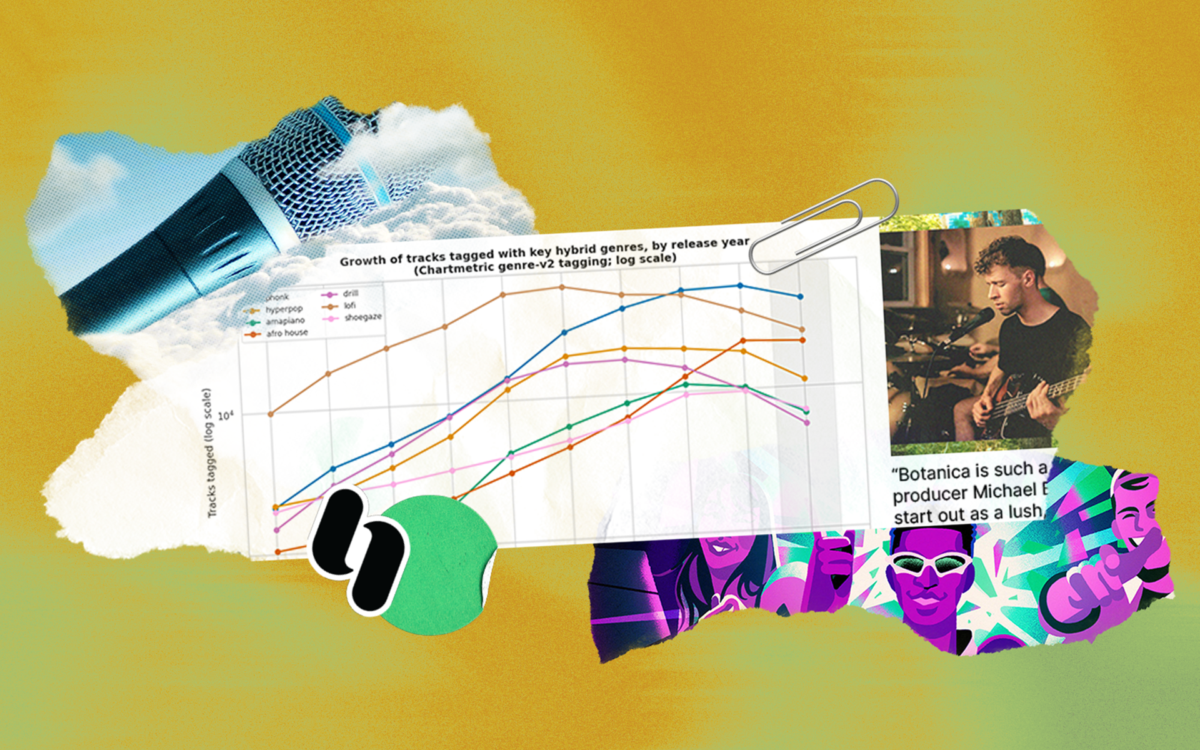
Genre isn’t static.
It’s constantly evolving, diversifying into sounds that are more specific, more hybrid, and more culturally fluid to reflect a generation of producers building across boundaries.
We recently teamed up with Chartmetric on a joint data report to examine the evolution of music genres together. Chartmetric tracks how the world listens to music, and Splice has insights into how the producers, artists, and creators make it. Neither tells the full story alone, but together, they reveal the arc from the moment a sound is being built to the moment it becomes an integral part of culture.
See the full report here, and learn more about some of the fastest-growing genres that surfaced from it below—we also provide some recommendations for relevant sounds that you can incorporate into your own productions.
1. Botanica
Also referred to as ‘petalcore,’ botanica music juxtaposes nostalgic timbres from acoustic instrumentation like piano, strings, guitars, and vocals with spectral processing and glitch elements. Monthly searches for botanica on Splice Sounds saw an explosive 25.5x growth between 2023 – 2024 and 2025 – 2026, making it the fastest-growing genre on Splice.
“Botanica is such a dynamic genre,” vocalist and producer Michael Bruner observes. “A track can start out as a lush, ambient symphony with no perceived rhythm, and then slam into a hyperpop-inspired section. The dynamics and arrangement are so open-ended. Some tracks are just purely meditative, while others can have a more conventional pop song arrangement.”
If you want to explore the immersive sounds of botanica in your own music creation process, here are a few powerful starting points:
- Botanica Essentials
- Serum 2 Botanica
- Resonance Botanica, a phritz moment
- Vocal Botanica – Michael Bruner
- Botanica presets on Splice
- More botanica samples on Splice
Learn more about the key characteristics, popular tools, and production techniques behind botanica in our dedicated guide below:
2. Jerk
Jerk is a subgenre of hip hop that has exploded in the 2020s. It draws inspiration from the original 2000s wave of jerk rap and street dance culture, while incorporating modern influences like internet rap.
Notable artists commonly associated with jerk include xaviersobased, phreshboyswag, Nettspend, and fakemink, and the genre has seen a rapid 16.1x increase in monthly searches.
Here are a few different sources where you can explore the percussive, underground, and often abrasive sounds of jerk firsthand:
- Jerk Drill
- Toolkits: Jerk Drum Kit
- Songstarters: Underground Rap
- maak – Ultimate Jerk
- More jerk samples on Splice
3. Cloud rap
Cloud rap is among hip hop’s most influential and controversial subgenres, marked by its ethereal, atmospheric productions and largely region-less online origins. Its leading artists merged influences from the 808-heavy Southern hip hop coming out of Atlanta, Houston, and Memphis with the hazy sounds of witch house and chillwave.
“Cloud rap is known for its obscure sample choices—anything from anime soundtracks to new-age music is fair game, and chopping, pitching, and drenching in reverb are hallmarks of the sound,” producer and DJ umru explains. “Most hip hop scenes have formed around specific regions and cities, but cloud rap may be one of the first to fully emerge from online platforms like MySpace, music blogs, and later SoundCloud.”
Cloud rap has seen a 5.1x increase in monthly searches on Splice—here are some packs and presets you can explore to get acquainted with its enigmatic sound:
- Toolkits: Cloud Rap Drum Kit
- Toolkits: Cloud Rap Serum Presets
- HOMAGE: Clams Casino
- More cloud rap samples on Splice
Dive deeper into cloud rap’s early influencers and pioneers, key sonic characteristics, and production elements below:
4. Amapiano
Amapiano is a South African genre that blends influences from deep house, jazz, gqom, and lounge. Emerging in the 2010s, it’s known for its distinctive log drum basslines, smooth piano melodies, and rhythmic percussion.
“Amapiano, like many other African genres, is percussion-driven,” producer and artist Kooldrink tells us. “You’ve got to get the drum groove right for it to be amapiano—and the drums aren’t something you learn; you either feel it or you don’t.”
Amapiano has seen a 4.1x increase in monthly searches on Splice, and there are plenty of sounds that you can explore:
- Pop Amapiano
- Amapiano
- Kayomusiq – Amapiano Chords & Beats Vol. 1
- Sounds of Amapiano
- More amapiano samples on Splice
Kooldrink offers more insights into amapiano and walks through his creative process for producing music in the genre in the dedicated guide below:
5. Breakcore
Breakcore is a genre of electronic dance music that draws on jungle, hardcore, and drum and bass. Aggressive and chaotic, it’s built around the manipulation of breakbeats that are chopped, layered, and pitched.
Breakcore has seen a significant revival in recent years, driven by a renewed interest in ’90s rave culture and online communities that have blended it with influences from other genres like hyperpop, emo, and metal—this is also reflected in its 3.6x increase in monthly searches on Splice. The genre lends itself particularly well to the use of drum loops, and there are a wide array available that you can browse and download for further manipulation:
- Breakcore 404
- Console – Atmospheric Breakcore & Jungle
- Hollow – Breakcore
- More breakcore samples on Splice
6. Phonk
Phonk is a subgenre of hip hop that draws heavily from ’90s Memphis rap. It’s characterized by dusty drum patterns, pitched-down vocal samples, woozy melodies, and a deliberate lo-fi quality.
“‘Phonk,’ a misspelling of ‘funk,’ was first coined by rapper SpaceGhostPurrp to describe his own music: ‘real Miami phonk,’ as he put it,” producer and sound designer Vera Much says. “The name was inspired by the G-funk that SpaceGhostPurrp grew up hearing—he created the term ‘phonk’ with the intention to ‘kick it and chill back and keep the party rocking with style.'”
Last in this list but certainly still massive, phonk has seen a 3.1x increase in monthly searches on Splice—Brazilian phonk may also contribute to the term’s overall increased popularity, although its history, sonic characteristics, and culture stand distinct. Check out some sounds that embody these genres:
- Burnout – Phonk Tapes
- RARE – Tape Jams 5
- Vocal Brazilian Phonk
- Brazilian Phonk
- More phonk samples on Splice
Learn more about nuances of the roots and histories behind phonk as well as Brazilian phonk below:
Continue learning via Chartmetric’s full report
And there you have it! Hopefully these sounds and guides inspire you to create something new.
What other genres do you believe are on the rise? What topics in music production would you like to see us cover next? Start a conversation with us and an ever-growing community of music creators via the Splice Discord, and check out our full report with Chartmetric for more trends and insights on the state of genres.
Read our full report with Chartmetric:
July 27, 2026