.svg)
.svg)

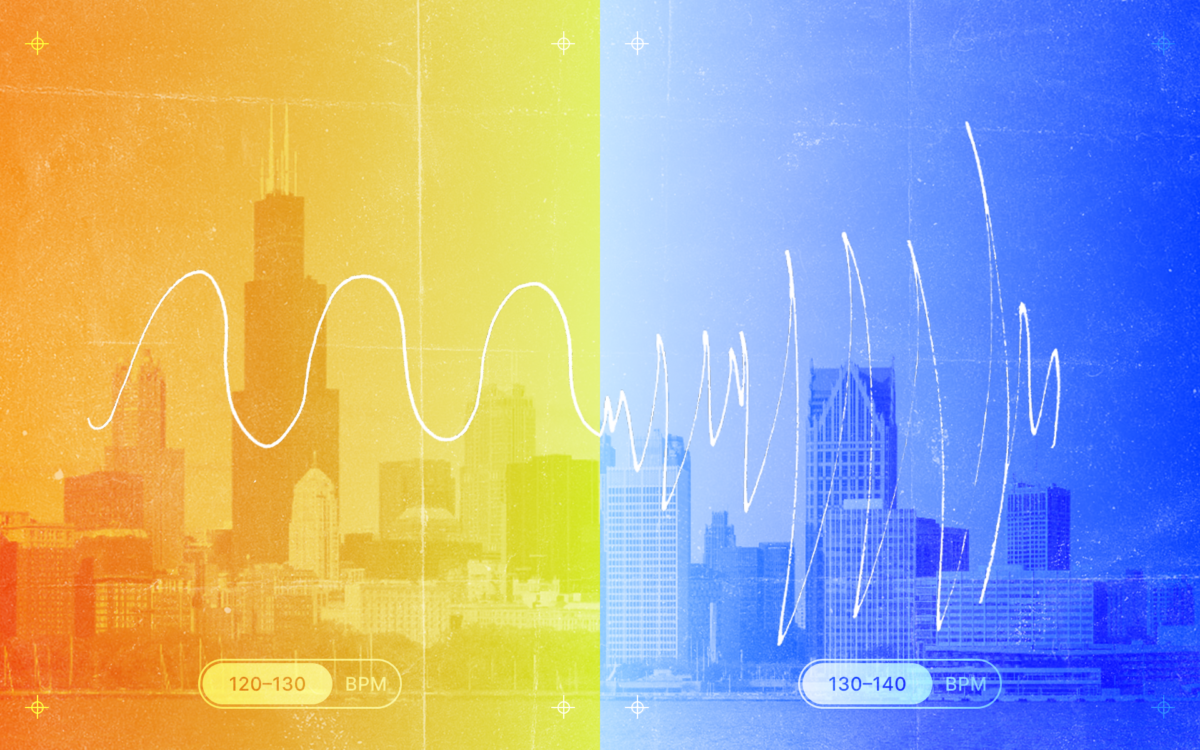
To understand the differences between house vs. techno music, we have to first examine their unique origins and innovators.
While these two pillar genres of electronic dance music share common ancestry, they developed at slightly different times and places.
Let’s dive right in!
Origins of house vs. techno
House music
Let’s start with house music. Originating in Chicago in the early 1980s and rooted in disco, soul, and funk, house music was forged in the city’s underground club scene, where pioneering DJs and producers were experimenting with prototypes of the genre. The genre’s name comes from The Warehouse, a Chicago nightclub where DJ Frankie Knuckles (often regarded as the “Godfather of House Music”) played from 1977 – 1982.
At the time, Knuckles was mixing disco, soul, and electronic music, and would extend tracks with a reel-to-reel tape machine, adding drum machine layers using the TR-808 and TR-909. When he moved to the Power Plant club, fans would ask record stores for “the music played at The Warehouse,” which eventually shortened to “house music.”
The first and earliest house records are disputed, but there are some generally accepted groundbreaking releases that most can agree on:
- Jesse Saunders – “On & On” (1984)
- J.M. Silk – “Music Is The Key” (1985)
- Marshall Jefferson – “The House Music Anthem (Move Your Body)” (1986)
- Steve “Silk” Hurley – “Jack Your Body” (1986)
- Farley “Jackmaster” Funk – “Love Can’t Turn Around” (1986)
Techno music
Techno, on the other hand, primarily originated in Detroit in the mid-1980s, and was centered around driving, mechanical, futuristic, and industrial sounds. While it developed nearly in tandem with Chicago house, the roots of techno can be traced back to a few key artists such as Juan Atkins, Derrick May, and Kevin Saunderson, who were collectively known as the “Belleville Three.” Their approach was to blend elements of funk, soul, and synth-heavy electronic music, drawing inspiration from Kraftwerk’s robotic rhythms and Giorgio Moroder’s heavy use of analog synthesizers.
This pioneering group helped pave the way for many other artists, with some of techno’s first tracks including:
- Juan Atkins – “Alleys Of Your Mind” (1981)
- Derrick May – “Nude Photo” (1982)
- Cybotron – “Clear” (1983)
- Model 500 – “No Ufo’s” (1985)
As techno and house music continued to evolve, they began to spread beyond their respective cities, gaining popularity in clubs and raves across the world. Techno in particular gained a strong following in Europe, where it merged with the existing acid house and EBM (electronic body music) scenes. The genre’s dark, industrial soundscapes resonated with fans of bands like Throbbing Gristle and Cabaret Voltaire, while its futuristic vibe appealed to those drawn to science fiction and cyberpunk.
At the same time, house music was gaining traction on both sides of the Atlantic. Chicago-based producers like Frankie Knuckles and Ron Hardy, along with European artists like Sven Väth and Laurent Garnier, helped spread the genre’s gospel to clubs from Ibiza to New York City. House music’s catchy melodies, infectious beats, and party-friendly atmosphere also made it a staple in the global club scene.
Tech house music
As these two movements crossed paths in clubs worldwide, producers began experimenting with combining elements from both styles, leading to the emergence of tech house in the early 1990s. This hybrid genre captured house music’s groove-driven energy and dancefloor appeal while incorporating techno’s minimalist production techniques and darker sonic textures.
Tech house found a middle ground—funky basslines and swinging rhythms met stripped-back arrangements and mechanical precision, creating a sound that appealed to fans of both parent genres.
Some of the earliest tech house tracks include:
- Animus Amor – “And On” (1993)
- Cajmere and Derrick Carter – “Dream States” (1992)
- Calisto – “Get House” (1995)
- LFO and F.U.S.E. – “Loop” (1995)
Key differences between house and techno
Let’s take a deeper look into the sonic characteristics of these genres from a music production perspective. Although house and techno share the same four-on-the-floor heartbeat, their pace and feel create very different moods on the dancefloor.
BPM, rhythms, and vibes
House:
Usually hovering around 120 – 130 BPM, house music thrives on funk, groove, and soul. Swinging hi-hats, syncopated claps, and warm basslines give it a human touch and rhythms that breathe. The energy often feels uplifting and emotional. House music generally feels a bit less robotic, more lively, and embodies an overall brighter character when compared to techno.
Techno:
Techno often runs a bit faster, from around 125 – 140 BPM, with a focus on straight, driving rhythms. Its pulse is mechanical and hypnotic, built to pull dancers into a trance rather than lift them up with melody. Instead of swing or groove, it leans into precision and repetition. It often also employs sounds that are darker, less joyful, and perhaps more futuristic-sounding in some cases.
On the dance floor, these distinctions completely change how DJs build their sets. House encourages flow, emotion, and vocal connection, while techno emphasizes momentum, tension, and endurance. A house set often feels like a celebration; a techno set feels like a journey through machinery and motion.
Sound design and arrangement
House:
On the sound design front, house music relies on highly rhythmic drum patterns paired with resampled melodic layers from funk, soul, and R&B, all tied together with groovy bass riffs. These core elements create house music’s signature sound and have spawned countless subgenres.
Warm chords, repetitive vocal samples, and melodic basslines also give house its distinct identity—but what makes it truly unique is how these elements function interchangeably as groove mechanisms. A vocal sample might become a percussive element, or a resampled funk loop could transform into the track’s rhythmic backbone.
Another key element of house music’s sound is its use of breakdowns and drops for energy shifts. These arrangement techniques take listeners on a journey while giving dancers crucial moments to catch their breath. By breaking the relentless rhythm, these sections allow the crowd to reset and remain on the dance floor with renewed energy when the beat drops back in.
Techno:
Techno, on the other hand, embraces minimalism and repetitive loops, emphasizing hypnotic and often mechanical percussion, synth stabs, textures, and drones. Sound design-wise, techno tends to feel less lively and more robotic, built around static grooves with minimal use of resampled material. While samples do appear in techno tracks, they’re typically used to create tension and atmosphere rather than serving as foundational elements.
Where house can feature chord progressions that move and evolve throughout a track, techno often locks into a single key (and sometimes even a single chord or note) for its entire duration. This commitment to repetitive loops and minimalism is what drives techno—the focus is on hypnotic progression over time, with subtle changes accumulating to create an immersive, trance-like experience.
Tech house:
Last but not least, tech house sits at the crossroads of these two worlds, taking the most characteristic elements from each parent genre. From house, it borrows the funky, melodic basslines and groove-oriented rhythms that keep dancers moving. From techno, it adopts the stripped-down production aesthetic and minimal arrangement philosophy that creates space and drive.
When compared to techno, this hybrid approach makes tech house potentially more versatile on the dance floor. It has enough groove and melody to keep the energy accessible and fun, but maintains the stripped-back, driving quality that allows DJs to mix tracks seamlessly over extended periods. Tech house doesn’t demand the emotional peaks of house or the relentless intensity of techno. Instead, it finds a sweet spot that keeps crowds locked in the pocket for hours.
Explore house and techno sample packs on Splice
If you’re ready to begin your journey navigating the differences between house vs. techno firsthand as a music creator, exploring artist-made samples from the respective genres on Splice Sounds can be a great place to start.
If you’re not sure where to start, a great example of a pack that explores the intersection between house vs. techno is Sample Magic’s Old Skool Rave, which features hundreds of classic synths, reworked breaks, pianos, and era-defining sounds recreated from the ground up. Another pack that has become a staple is Four4’s Minimal House & Techno, which blends the sensitivities across both genres in one unified collection.
We hope this article gave you a solid foundation on the differences between house, techno, and tech house music. What other genres would you like to see us dive into next? Start a conversation with us and an ever-growing community of music creators via the Splice Discord.
Explore royalty-free samples crafted by leading producers and sound designers spanning house, techno, and more:
November 19, 2025